Shape Puzzle Activity Benefits for Early Learning
Shape puzzles are effective early learning tools that support multiple areas of development. A well-structured Shape Puzzle Activity helps toddlers and preschoolers build fine motor skills, improve visual-spatial awareness, and develop early problem-solving abilities.
These activities involve identifying, matching, and fitting shapes, which require children to use hand-eye coordination, spatial reasoning, and basic logic. Shape puzzles also introduce early maths concepts such as size, symmetry, and categorisation.
In this article, we’ll explain how Shape Puzzle Activities support cognitive and physical development, and why they are commonly used in early childhood education settings.
Why Shape Puzzle Activities Matter in Early Learning
From an early age, children begin recognising shapes in their environment. A shape puzzle activity builds on this natural interest and turns it into structured learning. Matching and sorting shapes supports more than visual recognition – it also reinforces spatial awareness, memory, reasoning, and sensory exploration.
For example, when a toddler tries to place a square into a circular slot, they are practising trial and error, learning to compare visual cues, and developing problem-solving strategies. These are foundational cognitive processes linked to early academic success.
Developmental Benefits of Shape Puzzle Play
A well-designed shape puzzle activity targets multiple areas of early development.
- Cognitive development: Shape puzzles encourage toddlers to observe, compare, and make decisions. These experiences promote reasoning, problem-solving, and critical thinking.
- Attention and memory: As children progress, you may notice longer attention spans, improved memory, and greater persistence. Planning how to complete a puzzle strengthens working memory and goal-oriented thinking.
- Visual-spatial skills: Matching shapes and rotating pieces supports spatial reasoning, a foundational skill for geometry, early reading, and even map interpretation later in life.
- Fine motor skills and hand-eye coordination: Lifting, rotating, and placing pieces develops the hand control needed for writing, buttoning, and using tools like scissors or cutlery.
- Language development: Talking about shapes, colours, and actions during play introduces new vocabulary and builds descriptive language.
- Emotional regulation: Puzzle play encourages patience and frustration tolerance as children learn to persist through trial and error, improving their EQ.
- Confidence and independence: Completing a puzzle provides a sense of achievement, which boosts self-esteem and encourages independent learning.
These milestones typically emerge between ages 2 and 5 and are well supported through repeated exposure to shape puzzle activities.
Types of Shape Puzzles and Their Educational Uses
There are many types of shape puzzle activities available, and choosing the right one depends on your child’s age, skill level, and puzzle learning goals. Understanding the differences between formats can help you select puzzles that support development at every stage.
Two-Dimensional (2D) Shape Puzzles
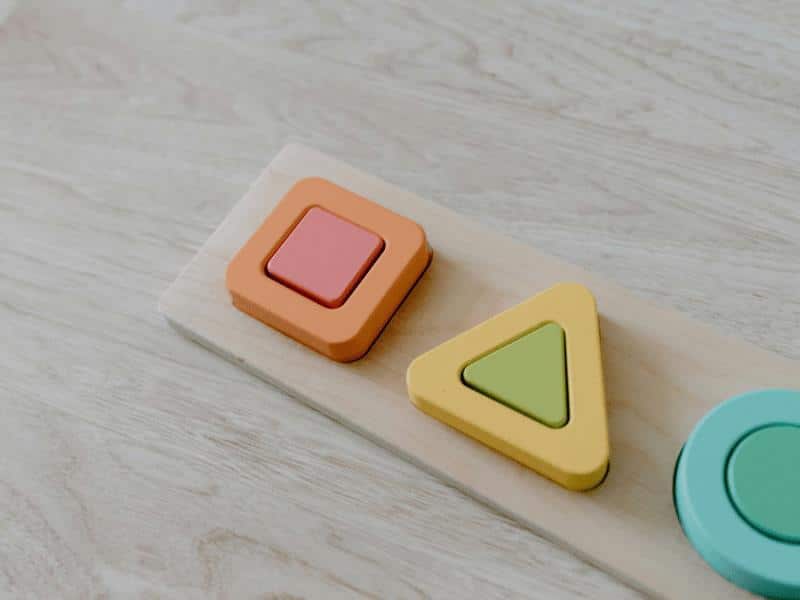
2D shape puzzles introduce children to basic geometric shapes like circles, squares, triangles, and hexagons. These are typically flat, board-style puzzles or cut-and-paste worksheets.
- Recommended age: 1 to 3 years
- Educational benefits: Supports visual discrimination, shape recognition, and matching
- Tips for parents: Choose puzzles with large, chunky pieces and simple designs featuring 3–5 distinct shapes for beginners. This builds confidence and reduces frustration.
Ideal for introducing spatial awareness and vocabulary like “side,” “corner,” or “curve.”
Three-Dimensional (3D) Shape Puzzles
3D shape puzzles use solid and are suitable for older toddlers and preschoolers who are ready to understand depth, volume, and structure.
- Recommended age: 3 to 5 years
- Educational benefits: Develops understanding of dimension, balance, and physical space
- Skill areas: Visual-spatial reasoning, early geometry, and fine motor planning
Learning to rotate objects to fit, strengthens both logic and coordination.
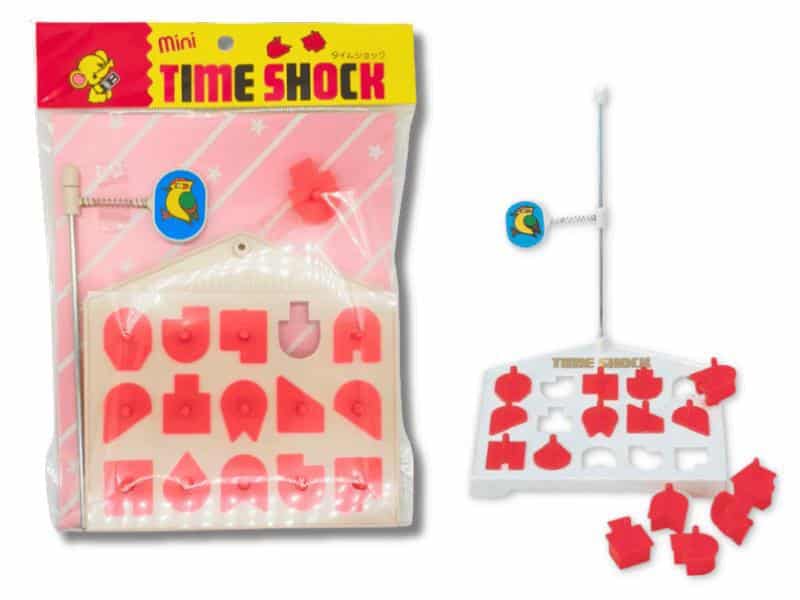
Photo: This Shichida shape puzzle activity challenges children to match abstract shapes under time pressure – promoting visual discrimination, quick thinking, and right-brain development in a fun and engaging format.
Shichida Shape Puzzles
Shichida shape puzzles, inspired by the Shichida Method from Japan, offer a unique blend of cognitive and emotional development.
- Design features: Includes abstract patterns that require whole-brain thinking
- Educational benefits: Promote right-brain stimulation, visual memory, and problem-solving through repetition and observation
- Approach: Focuses on nurturing creativity, concentration, and emotional confidence alongside academic growth
These puzzles are typically introduced in guided settings and are suitable for children who have already developed basic puzzle confidence.
Digital and Interactive Shape Puzzle Games
Digital shape puzzles use apps or online platforms to deliver interactive experiences with sound, motion, and instant feedback.
- Recommended use: Short sessions for toddlers and preschoolers
- Educational benefits: Reinforces shape recognition, sequencing, and hand-eye coordination
- Parent tip: Always balance screen time with real-world activities. Use digital puzzles alongside hands-on shape puzzle activities for best results.
Platforms like SHICHIDA at Home offer educational activities designed for skill reinforcement with parent involvement, including workbooks, songs, videos and more.
Remember: Use tech as a tool, not a substitute for physical learning experiences.
How to Choose the Right Shape Puzzle for Your Child
Every child develops at their own pace. While some enjoy challenging designs, others benefit from simpler puzzles that build confidence. Selecting the right shape puzzle activity depends on your child’s age, abilities, and learning goals.
Age-Appropriate Puzzle Selection Guide
Choosing age-appropriate puzzles ensures your child is engaged without feeling overwhelmed. Here’s a general guide:
- Ages 1–2: Start with large wooden boards featuring 3-4 basic shapes (circle, square, triangle). Look for knobs or handles to support grip development for toddlers.
- Ages 2–3: Introduce puzzles with 5-8 shapes. Begin incorporating colours, pictures, or animal-themed designs to support recognition and vocabulary.
- Ages 4–5: Offer more complex puzzles for preschoolers – such as layered puzzles, abstract shapes, or 3D shape puzzles – to challenge planning, reasoning, and memory. This is also a good stage to explore Shichida-style puzzles that integrate multi-step matching.
Parent tip: Observe how your child plays. If they complete puzzles quickly, it may be time to increase difficulty slightly to maintain engagement.
Safety and Material Considerations
Safety should always come first, especially for toddlers:
- Avoid small pieces for children under 2 to prevent choking hazards.
- Choose puzzles made from non-toxic, BPA-free plastic or sustainably sourced wood.
- Foam puzzles are soft and lightweight – ideal for babies or early walkers.
- If eco-friendliness matters, opt for recycled or compostable materials or consider making your own puzzles from cardboard or felt.
Parent tip: Always check for safety certifications such as AS/NZS ISO 8124 (Australia/New Zealand), EN71 (Europe), or ASTM F963 (USA) when buying toys.
Aligning Puzzles with Learning Goals
Think about what you want your child to gain from each shape puzzle activity:
- Emotional regulation: Puzzles offer quiet, focused time and can be soothing for children needing a calm-down activity.
- Independence: Choose puzzles they can complete without assistance to encourage self-reliance and perseverance.
- Academic reinforcement: Select puzzles aligned with classroom concepts, such as shape, colour, number, or sequencing.
Aligning your puzzle choices with developmental or learning goals ensures every session supports meaningful progress – not just entertainment.
Incorporating Shape Puzzle Play into Daily Routines
You don’t need to carve out long blocks of time to make puzzles effective. Just 10–15 minutes of focused shape puzzle activity each day can support your child’s development in meaningful ways.
Morning and Evening Learning Routines
Integrating puzzle play into daily transitions can help establish a balanced routine:
- Morning sessions: Use puzzles to activate focus and prepare the brain for learning. A simple shape puzzle activity can ease your child into the day with calm, purposeful play.
- Evening sessions: Wind down with quiet, screen-free puzzle time. This helps promote concentration and emotional regulation before bedtime.
Consistency is more important than duration – short, regular sessions build strong learning habits.
Puzzle Corners and Play Stations
Designate a small space in your home for puzzles and learning games. Keep it tidy, accessible, and inviting:
- Use a basket or tray to display 2–3 puzzles at a time
- Rotate puzzles weekly to maintain interest
- Include a mix of formats (e.g. 2D boards, 3D stacking puzzles, or homemade versions)
Having a visible and predictable puzzle space encourages children to initiate independent play and problem-solving.
Group Play and Social Development
Puzzles also provide opportunities for social learning. Whether it’s with siblings, friends, or a caregiver, Shape Puzzle Activities can be used for:
- Turn-taking games: Alternate who places a piece to build patience and cooperation
- Timed challenges: Work together or compete to complete a puzzle, promoting teamwork and focus
- Shared problem-solving: Discuss where a piece might go or how to complete a pattern
These activities reinforce communication, active listening, and flexible thinking – important social-emotional skills for school and life.
DIY Shape Puzzle Ideas for Home Learning
Shape puzzles don’t need to be store-bought to be effective. With a few simple materials and a bit of creativity, you can create engaging, hands-on learning tools at home that support your child’s development and spark curiosity.
Printable Shape Puzzle Worksheets
Websites like Top Teacher offer free or affordable 2D shape worksheets that you can print, laminate, and reuse.
- Great for quick, structured table-time
- Easy to include in-home learning binders or travel kits
- Support shape recognition, matching, and tracing skills
Tip: Use velcro dots or magnets to make pieces interactive for toddlers still building motor skills.
Recycled Materials for Custom Puzzles
Turn household items into learning tools with minimal prep:
- Use cardboard from cereal boxes or packaging to draw and cut out shapes.
- Trace household items (cups, lids, containers) to make custom shape outlines.
- Use fabric scraps or foam sheets to create soft, sensory puzzles.
Not only is this a sustainable option, but it also offers opportunities for parent-child collaboration – strengthening engagement while modelling creative problem-solving.
Hands-on creation supports both fine motor skills and ownership of the learning process.
Seasonal and Holiday-Themed Puzzles
Adding a theme keeps puzzle play fresh and meaningful:
- Christmas: Decorate a tree by matching ornament shapes
- Easter: Match egg halves based on shape or pattern
- Summer: Use suns, ice creams, or water drops to create themed puzzles
- Autumn: Leaf shape sorting or pumpkin puzzles
These seasonal shape puzzle activities help children connect learning with real-world events and family traditions – boosting engagement and memory retention.
Bonus: Let your child decorate the puzzle pieces themselves for added ownership and creativity.
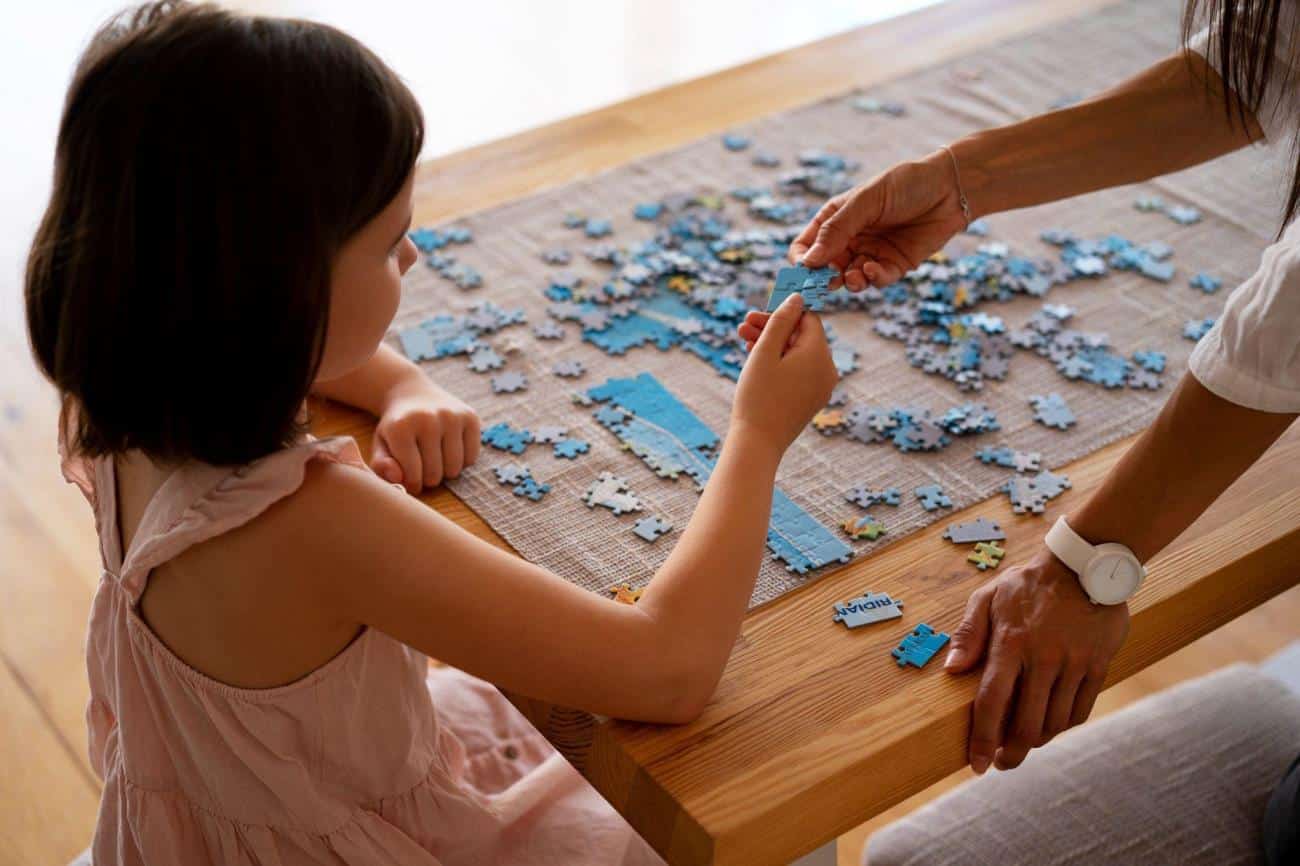
Photo from Freepik: Turn puzzle time into learning time. Traditional puzzles are a great way to spend quality time together once your child is ready for them.
Expert Tips from Shichida and Educators
Insights from Shichida educators and early learning professionals show that the way you approach puzzle play matters just as much as the activity itself. Here are two key strategies to help make the most of each shape puzzle activity at home.
Encouraging Independent Exploration
Give your child space to explore puzzles on their own. Independence builds confidence, problem-solving, and resilience. Set up a puzzle in a quiet area and allow your child to approach it at their own pace.
- Offer occasional prompts like “What do you notice about that piece?” rather than stepping in too quickly.
- Allow time for trial and error – this is where the learning happens.
- Celebrate effort, not just success, to build a growth mindset.
Tip: Let your child revisit puzzles they’ve already mastered. Repetition builds fluency and encourages independent learning.
Avoiding Common Mistakes in Puzzle Play
To get the most from shape puzzle activities, avoid these common pitfalls:
- Introducing puzzles that are too advanced: If the task feels overwhelming, children may disengage. Start simple and increase difficulty gradually.
- Hovering too closely: Give space for self-led exploration. Jumping in too often can reduce confidence.
- Offering answers instead of clues: Instead of showing where a piece goes, offer hints like “What else could fit here?”
- Using the same puzzle too often: Rotate puzzles weekly to maintain interest and provide fresh challenges.
Keeping the experience positive and pressure-free helps children associate learning with enjoyment – not stress.
Tracking Progress and Celebrating Milestones
Monitoring your child’s progress through shape puzzle activities not only helps you understand their development – it also boosts their motivation and confidence. Simple tools like charts or journals can make learning feel rewarding and meaningful.
Visual Charts and Sticker Systems
Visual progress tools provide immediate, positive reinforcement:
- Use a sticker chart or progress board to track puzzle completion, shape recognition, or time spent on a task.
- For each milestone reached – like finishing a new puzzle or naming all the shapes – your child earns a sticker, stamp, or small reward.
- Keep the chart visible to build excitement and a sense of ownership over their learning.
Celebrating small wins helps reinforce a growth mindset and builds intrinsic motivation.
Journaling Learning Experiences
A simple notebook or digital journal can be a powerful tool for reflection:
- Record key milestones such as “Identified triangle correctly” or “Completed a 6-piece puzzle without help”.
- Include photos of your child working on puzzles to document progress visually.
- Note emotional growth too – like showing patience or persistence.
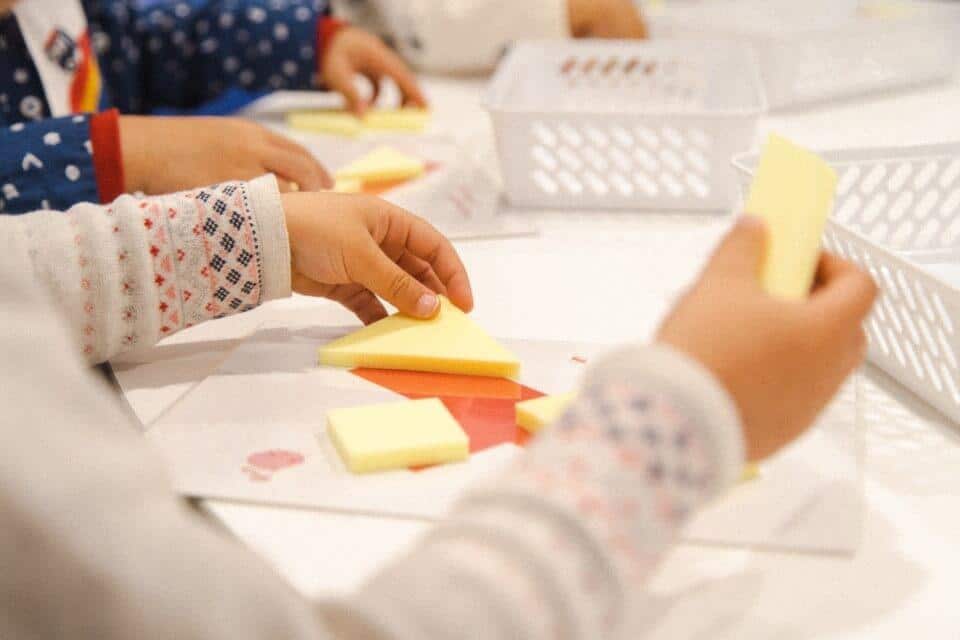
Photo by Shichida Australia: This tangram-based shape puzzle activity supports critical thinking, visual-spatial awareness, and fine motor development – all through hands-on exploration in a small group learning setting.
Shape puzzle activities at Shichida Australia help build strong foundations in early learning through hands-on, engaging play. From basic forms to advanced Shichida puzzles, each activity supports your child’s thinking, coordination, and problem-solving skills. Give your child a head start with guided learning that grows with them.
Book a trial class with Shichida Australia today and see the difference.
FAQ: Shape Puzzle Activity for Early Learning
You can begin introducing shape puzzle activities as early as 12 months. Start with large, chunky 2D puzzles that are easy to grasp. Increase complexity gradually as your child’s fine motor skills and focus develop.
Shape puzzles support cognitive development, improve fine motor coordination, enhance memory, and introduce early math and spatial reasoning skills. They also promote persistence, problem-solving, and hand-eye coordination.
Shichida puzzles follow a unique approach focused on right-brain development, pattern recognition, and self-directed learning. While these offer added cognitive challenges, traditional puzzles also play a valuable role – choose based on your child’s needs and your learning goals.
Use printable worksheets, make puzzles from recycled cardboard, or create themed puzzles linked to holidays (e.g. matching Easter eggs, snowflakes, or Spring flowers).
A consistent 10–15 minutes of focused shape puzzle activity daily is ideal. This keeps children engaged without overwhelming them and supports steady developmental progress.