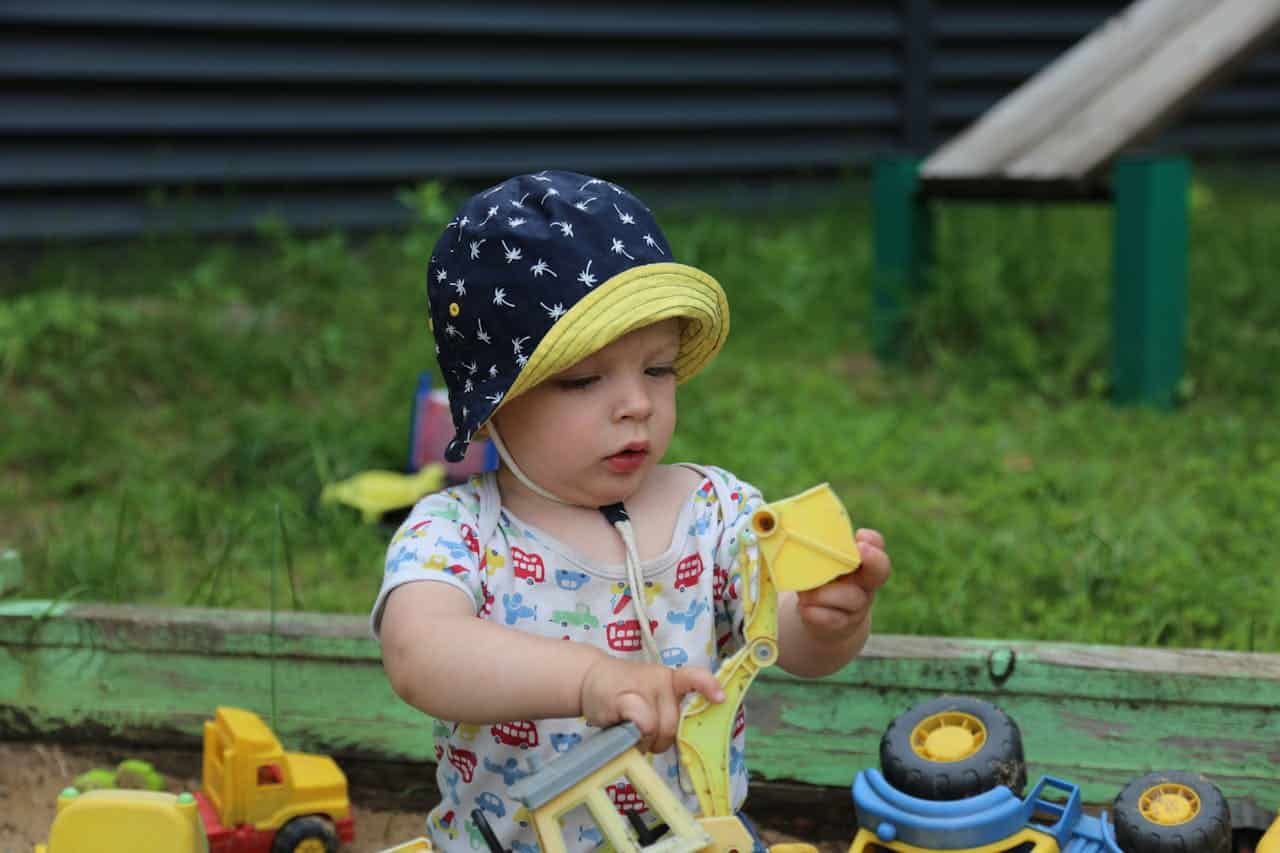

Understanding Child Cognitive Development
Every parent wants their child to grow into a confident, independent thinker. That journey begins early by nurturing child cognitive development through everyday interactions and intentional support.
Solving puzzles, asking questions and learning how to reason and make decisions, these early experiences shape a child’s ability to understand the world. Building strong cognitive skills in toddlers and young children lays the groundwork for academic success, emotional regulation, and social development.
This guide explores child cognitive development, including the mental development stages from babyhood through childhood, how to support cognitive development at home, what milestones to watch for, and when to seek help if delayed cognitive development is a concern.
Whether you’re focusing on learning through play or simply trying to better understand cognitive development in children, this article will help you guide your child toward a lifetime of learning and resilience.
What Is Cognitive Development in Children?
Cognitive development refers to how a child’s thinking and understanding grow over time. It includes mental skills like learning, problem-solving, memory, reasoning, and using language to make sense of the world. From infancy to adolescence, your child’s brain develops in stages, shaping how they see and interact with their surroundings.
One of the most well-known experts in this area, Swiss psychologist Jean Piaget, explained that children don’t think like adults from the start. Instead, they progress through four stages of cognitive development: the sensorimotor, preoperational, concrete operational, and formal operational stages. Each stage represents a major shift in how children process information, reason, and make sense of the world – highlighting the remarkable journey of child mental development as they grow.
Key Components of Child Cognitive Development
Child cognitive development includes a range of skills that help your child learn, solve problems, and grow into an independent thinker.
- Perception: This is how your child makes sense of what they see, hear, and feel – helping them understand the world right from the start.
- Memory: Memory helps your child store and recall information, which is essential for learning and decision-making.
- Attention: The ability to focus on one task at a time supports better learning and problem-solving.
- Language: Communicating thoughts and understanding others is a big part of both cognitive and social development.
- Learning: Children learn through play, routine, and school – constantly picking up new knowledge and skills.
- Reasoning: As your child grows, their ability to think critically, make connections, and understand cause and effect strengthens.
These skills are all connected. Together, they support cognitive development in children, helping them adapt to new situations, solve problems and make sense of the world.
Why Cognitive Development Matters
Cognitive development is crucial to many aspects of your child’s life.
- Academic Performance: Strong thinking and problem-solving skills help children succeed in reading, math, and other school subjects.
- Emotional Regulation: As cognitive abilities grow, children are better able to manage their emotions, build resilience, and cope with everyday challenges.
- Social Functioning: Cognitive growth helps children understand social cues, show empathy, and navigate friendships and group settings more confidently.
When parents and educators understand how to support cognitive development in children, they can introduce strategies that improve learning, behaviour, and overall wellbeing – setting kids up for long-term success.
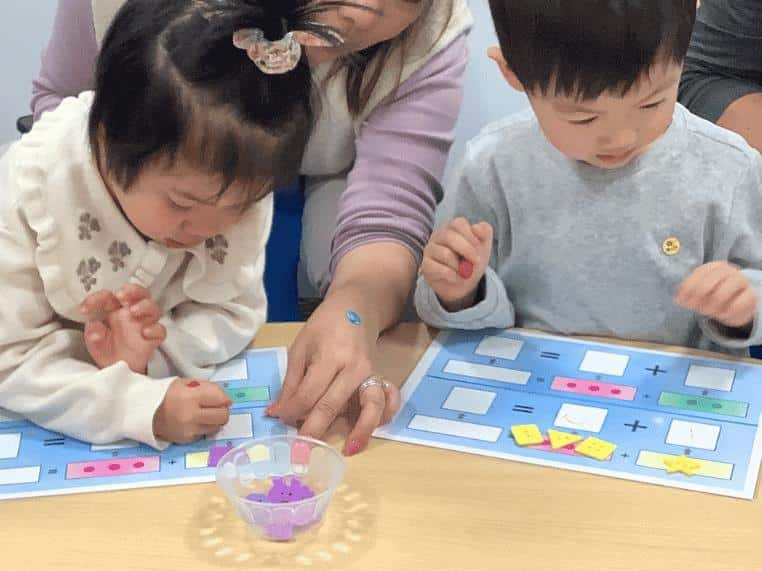
Photo by Shichida Australia: Child Cognitive development is promoted through hands-on play, solving challenges and partaking in games that encourage problem-solving.
Piaget’s Stages of Child Cognitive Development
As a parent, understanding how your child thinks and learns can be incredibly helpful. One of the most well-known theories in child psychology comes from Jean Piaget, who explained that children go through four distinct stages of cognitive development.
Piaget’s theory of child cognitive development suggests that children don’t just learn more information as they grow – they actually think in fundamentally different ways at each stage. These changes reflect growing mental abilities and behaviours, not just age.
Sensorimotor Stage (0–2 years)
In the sensorimotor stage of child cognitive development, babies learn through direct sensory and motor experiences. Touching, seeing, moving, and manipulating objects help them understand their environment.
Key characteristics:
- Learning through trial and error.
- Development of object permanence (understanding that objects still exist even when out of sight).
- Early signs of goal-directed behaviour.
Examples:
- Shaking a rattle to make noise.
- Reaching for a hidden toy.
- Exploring objects by mouthing or banging them.
Preoperational Stage (2–7 years)
During the preoperational stage of child cognitive development, children begin using symbols – words, images, and objects – to represent things. Language skills and imagination flourish, but logical thinking is still limited.
Key characteristics:
- Egocentrism (struggles to understand other viewpoints).
- Animism (believing non-living things have feelings).
- Centration (focusing on one aspect of a situation).
Examples:
- Pretending a broom is a horse.
- Believing the moon follows them.
- Thinking a taller glass holds more juice, even if both have the same volume.
Concrete Operational Stage (7–11 years)
In the concrete operational stage of child cognitive development, children develop more logical thinking about real-world situations. They understand concepts like conservation (quantity stays the same despite changes in shape) and reversibility (actions can be undone).
Key characteristics:
- Logical thought about concrete events.
- Understanding cause and effect.
- Less egocentric thinking.
Examples:
- Realising that pouring water into a different container doesn’t change its amount.
- Sorting objects by size or colour.
- Following multi-step directions independently.
Formal Operational Stage (12+ years)
In the formal operational stage of child cognitive development, abstract and hypothetical thinking emerges. Teenagers can form ideas about the future, analyse abstract problems, and use logic to reason through complex issues.
Key characteristics:
- Abstract and critical thinking.
- Hypothetical reasoning.
- Metacognition (thinking about thinking).
Examples:
- Debating moral or philosophical topics.
- Designing an experiment to test a theory.
- Reflecting on thoughts, feelings and beliefs.
Key Cognitive Skills and Milestones by Age
While cognitive development generally follows a predictable path, it’s important to remember that every child develops at their own pace. These typical milestones offer a helpful guide for what you might expect as your child grows.
Infants (0–12 months)
- Begin to develop object permanence (understanding that objects still exist even when out of sight)
- Recognise cause-and-effect relationships (e.g. shaking a rattle makes noise)
- Start to imitate sounds, facial expressions, and simple actions
Toddlers (1–3 years)
- Engage in symbolic play (e.g. pretending a block is a phone)
- Show a burst in language development – naming objects, forming simple phrases
- Improve memory by recalling familiar routines, people, and objects
Preschoolers (3–5 years)
- Expand imaginative thinking and participate in storytelling or fantasy play
- Begin to understand basic counting, recognise numbers, and identify patterns
- Sequence events in order, showing stronger narrative and logic skills
School-aged Children (6–12 years)
- Use logical reasoning to solve problems, sort and classify objects
- Strengthen reading comprehension and begin to write in more structured ways
- Understand concepts of time, quantity, and measurements
Adolescents (13–18 years)
- Develop abstract and hypothetical thinking (e.g. debating, philosophical questions)
- Show more advanced decision-making with awareness of consequences
- Engage in future planning and begin setting long-term personal goals
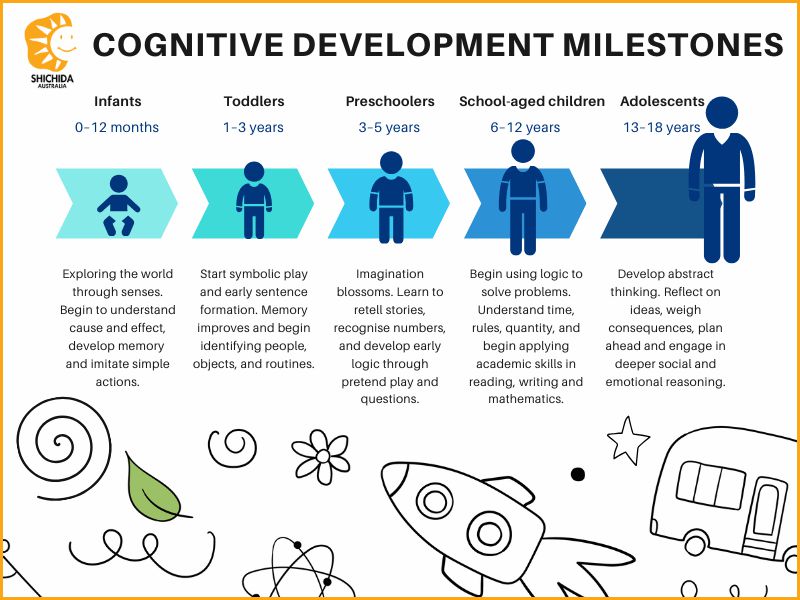
Image by Shichida Australia: Child cognitive development milestones timeline
Factors That Influence Child Cognitive Development
Your child’s cognitive development is shaped by a combination of internal and external influences. Understanding these factors allows you to create a supportive environment that promotes healthy mental development.
Biological and Genetic Factors
Some aspects of cognitive ability, such as memory, attention span, and learning capacity, are influenced by genetics. Neurodevelopmental conditions like ADHD, autism spectrum disorder, or dyslexia may also affect how your child processes information and learns new skills. Brain health during pregnancy and early infancy – including birth complications or early illnesses – can play a critical role in shaping cognitive growth. Early support and appropriate interventions can make a significant difference.
Environmental Stimulation and Education
A rich learning environment helps cognitive skills thrive. Simple activities like reading together, building with blocks, solving puzzles, building with blocks, and playing interactive games encourage problem-solving skills, creativity and critical thinking. Early childhood education programs and responsive, language-rich interactions at home also contribute to strong brain development and prepare children for lifelong learning through memory development and early language skills.
Nutrition and Sleep
Brain development in children depends heavily on proper nutrition. Nutrients such as omega-3 fatty acids, iron, and vitamins A, D, and B-complex are essential for attention, memory, and focus. A poor diet can delay development and affect school performance. Equally important is sleep. During rest, the brain processes information and strengthens new learning. Without enough sleep, children may struggle with concentration and emotional regulation. A consistent sleep routine is key to supporting healthy cognitive growth.
Activities To Support Child Cognitive Development at Home
Supporting your child’s cognitive development doesn’t have to be complicated. Simple, consistent activities at home can make an impact. Age-appropriate games, educational toys, daily storytelling and encouraging routines can all promote stronger thinking, memory, and problem-solving skills.
Play-Based Learning
Play-based learning is one of the most effective ways to strengthen early childhood cognitive development. Through playful exploration, your child builds mental skills without pressure.
- Pretend play boosts creativity, imagination, and symbolic thinking.
- Blocks and construction toys support spatial awareness, logic, and problem-solving.
- Puzzles improve memory, attention, and perseverance by challenging your child to complete a task step-by-step.
These play experiences lay the foundation for later academic learning and critical thinking.
Reading and Storytelling

Photo from Pexels: Storytelling isn’t just entertainment, it’s a powerful child cognitive developmental tool for learning.
Storytelling is more than entertainment – it’s one of the most powerful cognitive development activities for kids.
- Reading aloud introduces new words, patterns, and sentence structures.
- Listening to or creating stories strengthens memory, sequencing, and understanding cause and effect.
- Asking questions like “What do you think happens next?” encourages prediction and reasoning.
Reading even 10–15 minutes a day helps support early literacy and language development while building essential thinking skills.
Encouraging Questions and Exploration
Helping your child become a curious, independent thinker starts with how you respond to their natural questions.
- Welcome “why,” “how,” and “what if” questions – they show your child is thinking deeply.
- Offer open-ended activities like nature walks, baking, or simple science experiments.
- Give space for trial and error. Let them try, fail, and try again – this builds resilience and real-world problem-solving ability.
Creating a home environment that encourages exploration, rather than perfection, helps children become confident learners.
Common Child Cognitive Development Challenges
While most children progress through the stages of cognitive development at their own pace, some may experience delays in specific areas. Issues such as delayed speech, difficulty focusing, or memory challenges can raise concerns for parents.
It’s important to remember that delayed cognitive development doesn’t always indicate a long-term problem – children develop at different rates, and many catch up with time, support, and patience.
Recognising early signs and knowing when to seek professional guidance can help your child receive the right support at the right time.
Early Warning Signs of Delays
While variation is normal, certain signs may suggest your child would benefit from closer observation or early intervention:
Infants (0–12 months):
- Limited eye contact or lack of social smiling
- Delayed response to sounds or little to no babbling
- Difficulty visually tracking objects
Toddlers (1–3 years):
- Using very few words or not forming two-word phrases by age two
- Trouble understanding simple directions like “come here” or “give me the ball”
- Little interest in exploring or playing with toys
Preschoolers (3–5 years):
- Difficulty following two-step instructions
- Trouble recalling daily routines or familiar activities
- Struggles identifying basic concepts like colours or shapes
School-aged Children (6–12 years):
- Ongoing difficulties with reading, writing, or math
- Short attention span or easily distracted
- Trouble organising thoughts or completing multi-step tasks
Adolescents (13–18 years):
- Difficulty with abstract thinking or logical reasoning
- Trouble planning ahead, making decisions, or managing time
- Persistent memory issues or challenges focusing for extended periods
When to Consult a Specialist
If you notice consistent challenges in your child’s cognitive growth or your instincts tell you something’s not quite right, don’t hesitate to seek help. Early intervention makes a significant difference, especially when addressing delayed cognitive development.
Professionals who can support your child include:
- Pediatricians – for general developmental checks and referrals
- Child psychologists – for in-depth assessments and behavioural observations
- Speech and language therapists – if language or communication seems behind
- Educational psychologists or learning specialists – for school-based learning evaluations
Trust your gut – you know your child best. Early support is not about labelling. It’s about empowering your child with the tools they need to become the best version of themselves.
How Parents Can Support Their Child’s Cognitive Growth
Supporting your child’s cognitive development isn’t limited to structured lessons or educational programs. It’s about creating an environment – at home and in daily life – that nurtures curiosity, encourages exploration, and builds the emotional safety children need to learn and grow.
Consistent support, positive reinforcement and meaningful interaction lay the groundwork for strong mental development.
Create a Learning-Friendly Environment
A rich, engaging environment gives children daily opportunities to practise thinking, problem-solving, and memory. Whether your child is exploring through play or reading a book with you, your home can be a powerful space for learning.
Tips for a learning-friendly space:
- Natural light: Provide access to daylight or warm, soft lighting to create an inviting area for activities like reading, puzzles, or drawing.
- Quiet time zones: Designate distraction-free areas or time slots for focused tasks. This helps build attention span and self-regulation.
- Tech use with purpose: Limit passive screen time and instead opt for interactive digital tools or hands-on activities. Board games, flashcards, and sensory play offer far more cognitive stimulation than watching non-educational videos.
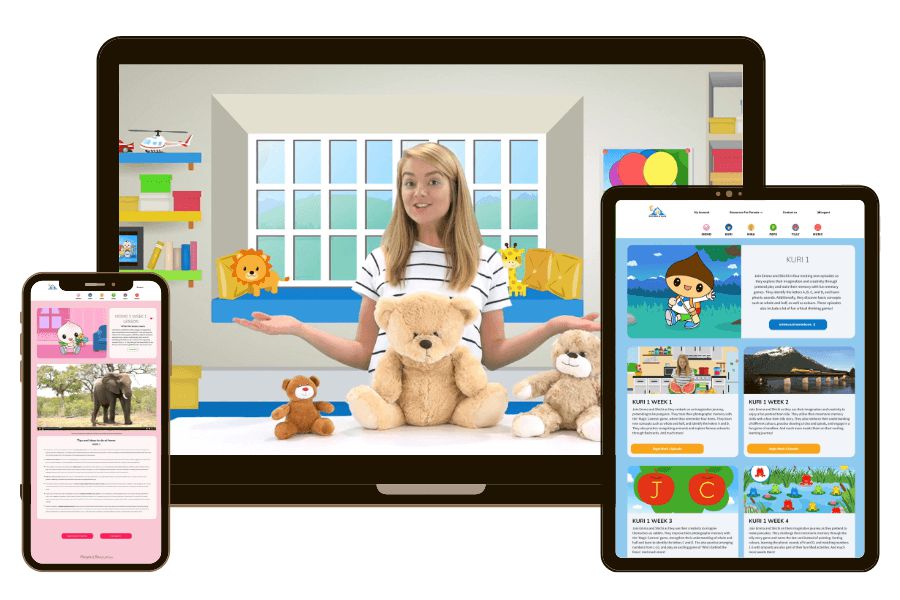
Photo by SHICHIDA at Home: Opt for an at home educational platform that is engaging and interactive – for example workbooks, interactive videos, songs and flashcards. SHICHIDA at Home is suitable for ages 1 to 5.
Emotional Safety Supports Mental Growth
A secure emotional environment is just as important as cognitive stimulation. Children learn best when they feel safe, supported, and valued.
How to build emotional security:
- Strong caregiver bonds: A secure attachment with parents or carers gives children confidence to explore their world and take on cognitive challenges.
- Stress management: Chronic stress can impair attention, working memory, and decision-making. Help your child manage stress with consistency, comfort, and calm responses during big emotions.
- Positive reinforcement: Praise your child’s effort – not just the result. This builds intrinsic motivation and resilience, two traits closely linked to long-term cognitive growth.

Photo by Shichida Australia: preschoolers solve a fun 3D tangram puzzle challenge in a Shichida class. This activity develops fine motor skills, critical thinking and spatial awareness.
At Shichida Australia, we focus on developing your child’s cognitive skills through proven early learning methods. Our classes are designed to strengthen memory, focus, language, and problem-solving abilities in a nurturing, play-based environment. Every activity is thoughtfully designed to support child cognitive development during the most critical early years.
Book a trial class today and see how your child can thrive with Shichida’s whole-brain approach.
FAQs Child Cognitive Development
According to Piaget’s theory of cognitive development, the four key stages are:
- Sensorimotor Stage (0–2 years): Babies learn through touch, movement, and interaction. A major milestone is understanding object permanence (that things still exist even when out of sight).
- Preoperational Stage (2–7 years): Children begin using language and imagination but often think in egocentric ways and struggle with logic.
- Concrete Operational Stage (7–11 years): Children start thinking logically about concrete ideas and understand concepts like conservation, time, and cause-and-effect.
- Formal Operational Stage (12+ years): Teens develop abstract thinking, hypothetical reasoning, and the ability to reflect on their own thoughts (metacognition).
Potential signs of delayed cognitive development may include:
- Limited or delayed speech and language
- Difficulty understanding basic concepts like colours, numbers, or shapes
- Short attention span or trouble following instructions
- Poor memory recall or lack of curiosity and imagination
If you notice ongoing difficulties, consult your child’s pediatrician or an early childhood specialist.
You don’t need fancy toys – simple, interactive activities are best. Try:
- Building blocks: Develops spatial awareness and logic.
- Pretend play: Supports symbolic thinking and creativity. Puzzles: Strengthens memory and problem-solving.
- Reading aloud: Encourages early language and comprehension.
- Memory games: Improves attention and recall.
Play is essential for early brain development. It:
- Strengthens problem-solving and language
- Develops creativity, imagination, and social learning
- Builds memory, attention span, and flexible thinking
Learning through play supports every aspect of a child’s cognitive development.
Occasional forgetfulness is normal, but seek guidance if your child:
- Regularly forgets daily routines or familiar information
- Struggles to remember past events or learned material
- Shows ongoing difficulty recalling names, instructions, or experiences
Persistent memory concerns may benefit from evaluation by a pediatrician, occupational therapist, or educational psychologist.